
The Research Group “Classic and Medieval Studies” at the USC (GI-1908) is formed by researchers on Greek and Latin texts at the Department of Classical, French and Italian Philology at the University of Santiago (in its campuses of Santiago de Compostela and Lugo)
Since 2015 is a Competitive Reference Group recognized by the Xunta de Galicia. This website is intended to serve as a way of communicating research results, as a presentation space of its activities and as a space for connection among researchers
News
Thesis’ Defense of Elena García Paleo
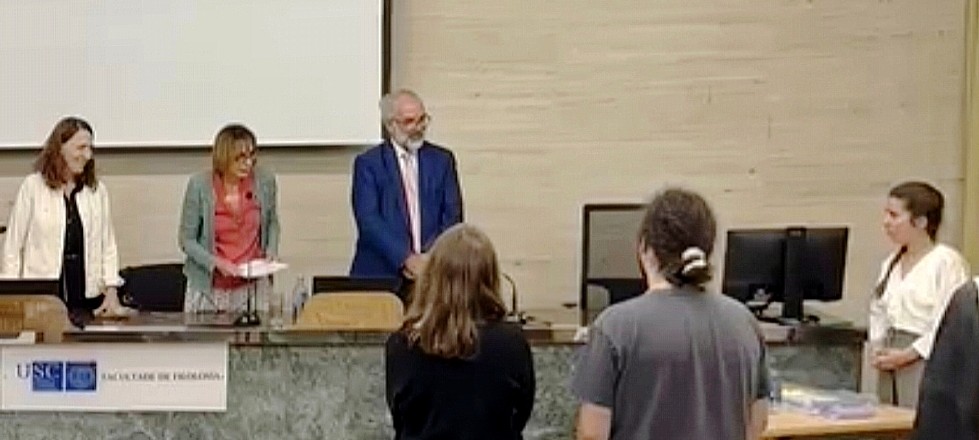
On September 18, 2026, Elena García Paleo defended her Doctoral Thesis—Ritual Aischrology and Alexandrian Literary Debates: A Comparative Study of the Poetics of Callimachus and Apollonius of Rhodes in Light of Ancient Hermeneutics—supervised by Associate Professor of Greek Philology María Teresa Amado Rodríguez. The defence took place before a committee chaired by Lucía Rodríguez-Noriega Guillén, Professor of Greek Philology at the University of Oviedo, and also included Begoña Ortega Villaro, Associate Professor of Greek Philology at the University of Burgos, and Ángel Ruiz Pérez, Associate Professor at the University of Santiago.
The thesis was unanimously awarded the grade of Sobresaliente cum laude.
In his dissertation, Elena García analyses the treatment of ritual aischrology in the poetry of Callimachus and Apollonius of Rhodes from a perspective attentive to ancient hermeneutics. More specifically, her research conducts a comparative examination of the portrayal of this phenomenon in Aetia I and The Argonautica with the aim of determining to what extent the differences between the two poems reflect divergent ideological positions regarding a question of a philosophical-hermeneutical nature: the value of aischrological language as a tool for knowledge. To this end, the study places this aspect of the works of Callimachus and Apollonius of Rhodes in dialogue with the writings on religious aischrology by key figures in the development of ancient hermeneutic thought—such as Plato, Aristotle, and Chrysippus—, writings that allow for the reconstruction of various positions within the hermeneutic debate regarding the epistemological value attributed to aischrological language in antiquity. This comparative perspective allows us to situate the portrayal of ritual and religious aischrology identified in Aetia and the Argonautica within the framework of a central discussion in ancient hermeneutics: the one that reflects on the capacity of language —even in its most transgressive forms— to convey, reveal, or make accessible the knowledge of truth.
.
.
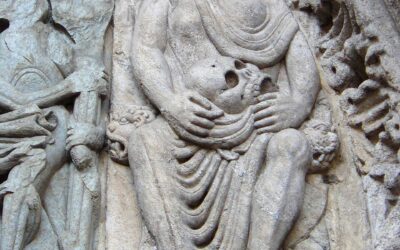
The Adulteress Punished on the Platerías Portico
José María Anguita Jaén, a professor of Latin Philology in Lugo, has just published an extensive and in-depth study regarding the image of a woman holding a skull to her bosom—sculpted on the Platerías Portico of the Cathedral of Santiago de Compostela (ca. 1100)....
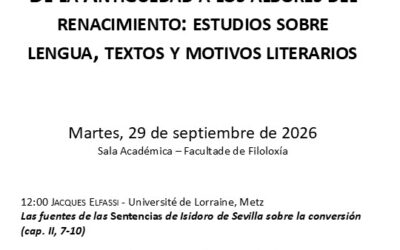
7th International Research Meeting
Organizada polo Grupo de investigación de Referencia Competitiva“Estudos Clásicos e Medievais” (CLASMED GI-1908) DE LA ANTIGÜEDAD A LOS ALBORES DEL RENACIMIENTO: ESTUDIOS SOBRE LENGUA, TEXTOS Y MOTIVOS LITERARIOS 29 de septiembre de 2026Sala Académica – Facultade de...

Collective volume in memory of Manuel Cecilio Díaz y Díaz
The publishing house SISMEL-Edizioni del Galluzzo has just released the volume Autori, testi e manoscritti fra la penisola iberica e l’Italia: da Gregorio Magno a Gregorio VII. In ricordo di Manuel Cecilio Díaz y Díaz, which contains several contributions consistent...

Lecture by Professor Edmondson
Next Tuesday, October 28th, at 12 noon in the Sala Académica of the Faculty of Philology, Professor Henry T. Edmondson III, from Georgia College and State University, Milledgeville (Georgia, USA), will give a lecture on “Aristotle and Leisure.”

Seminar Épica flavia e interludios virgilianos
On Monday, 22 September 2025, the Faculty of Philology at USC will host the sixth edition of the international research meetings organised by the Group for Classical and Medieval Studies (Clasmed, GI–1908). The seminar Épica flavia e interludios virgilianos will...

V Encuentro de Actualización Científica de ClasMed – Lunes 26 de mayo
El próximo lunes 26 de mayo se celebrará el V Encuentro de Actualización Científica del grupo de investigación ClasMed, una jornada dedicada al intercambio académico en torno a la lingüística latina y griega, en memoria de la profesora Concepción Cabrillana. La...