
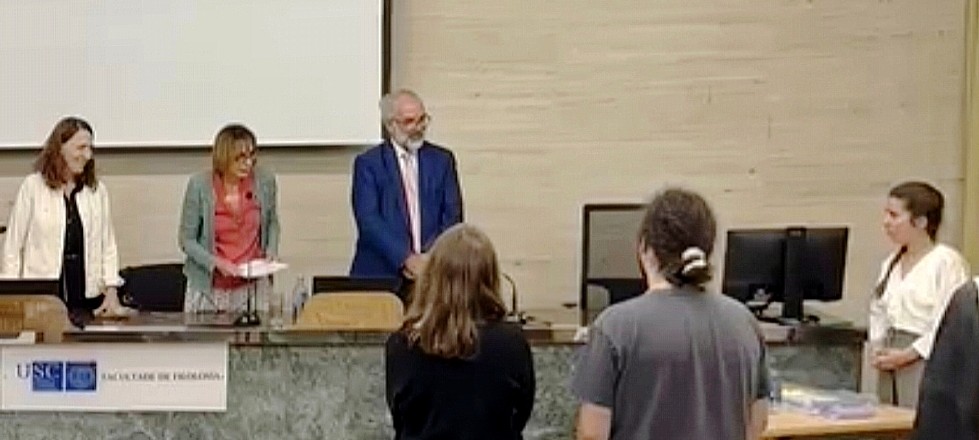
On September 18, 2026, Elena García Paleo defended her Doctoral Thesis—Ritual Aischrology and Alexandrian Literary Debates: A Comparative Study of the Poetics of Callimachus and Apollonius of Rhodes in Light of Ancient Hermeneutics—supervised by Associate Professor of Greek Philology María Teresa Amado Rodríguez. The defence took place before a committee chaired by Lucía Rodríguez-Noriega Guillén, Professor of Greek Philology at the University of Oviedo, and also included Begoña Ortega Villaro, Associate Professor of Greek Philology at the University of Burgos, and Ángel Ruiz Pérez, Associate Professor at the University of Santiago.
The thesis was unanimously awarded the grade of Sobresaliente cum laude.
In his dissertation, Elena García analyses the treatment of ritual aischrology in the poetry of Callimachus and Apollonius of Rhodes from a perspective attentive to ancient hermeneutics. More specifically, her research conducts a comparative examination of the portrayal of this phenomenon in Aetia I and The Argonautica with the aim of determining to what extent the differences between the two poems reflect divergent ideological positions regarding a question of a philosophical-hermeneutical nature: the value of aischrological language as a tool for knowledge. To this end, the study places this aspect of the works of Callimachus and Apollonius of Rhodes in dialogue with the writings on religious aischrology by key figures in the development of ancient hermeneutic thought—such as Plato, Aristotle, and Chrysippus—, writings that allow for the reconstruction of various positions within the hermeneutic debate regarding the epistemological value attributed to aischrological language in antiquity. This comparative perspective allows us to situate the portrayal of ritual and religious aischrology identified in Aetia and the Argonautica within the framework of a central discussion in ancient hermeneutics: the one that reflects on the capacity of language —even in its most transgressive forms— to convey, reveal, or make accessible the knowledge of truth.
.
.